
Seniority: The Term That Actually Costs You
Seniority decides whether the preference stack pays everyone at once or one round at a time. Under pari passu all preferred share the shortfall in proportion to what they put in; under a stacked structure the latest round is paid in full before a dollar moves down to anyone else.
Senior liquidation preferences appeared in 21% of Series B-and-later rounds in 2025, and in 46% of down rounds — Wilson Sonsini, Q1 2026. Those are not insignificant numbers! The point is that you’re far more likely to face senior liquidation preferences so this merits a deep dive.
Under a pari passu stack, preferred shareholders receive proceeds proportional to capital invested when there isn’t enough to make all investors whole.
On the other hand, under a stacked or senior structure, the most senior (typically the largest investor in the latest round) gets paid first until they’re made whole, before moving to the next most senior. Angel investors inevitably end up holding the most junior liquidation preferences and become the last investor to receive capital, only ahead of common shares.
The mechanics of how proceeds move through the stack are covered in our piece on the distribution waterfall. What matters is what the stack costs the person beneath it.
What a Preference Stack Costs an Early Investor
A preference stack costs the earliest investor their ownership percentage. Below the total capital raised, an angel is paid in proportion to the preference dollars they hold rather than the shares they own, and those two numbers are not close.
Let’s examine a company that has raised 3 priced rounds — seed, Series A and Series B. All investors have non-participating liquidation preferences.
We calculate the distribution waterfall for pari passu vs stacked liquidation preferences to illustrate how angel investors are more adversely impacted in the latter case.
The distribution principle for pari passu liquidation preferences is that investors receive up to 1x liquidation preference in proportion to each holder's aggregate liquidation preference — price per share × shares held which in this case amounts to invested capital.
The below table calculates cash distributions in a $10 MN exit. Since total liquidity is less than the $27.5 MN capital invested, pari passu mandates that investors receive an equal portion of distribution relative to their capital invested.
| Shareholder | Capital Invested ($) | Distributions up to 1x (%) | Equity Ownership % | Cash from $10 MN exit ($) | % Recovered |
|---|---|---|---|---|---|
| Common — founders and employees | — | 0% | 33.33% | — | — |
| Angel / seed at $0.50 | $1.5 MN | 5.5% ($1.5 MN / $27.5 MN) | 16.67% | $545k | 36% |
| Series A at $1.50 | $6 MN | 21.8% ($6 MN / $27.5 MN) | 22.22% | $2.18 MN | 36% |
| Series B at $4.00 | $20 MN | 72.7% ($20 MN / $27.5 MN) | 27.78% | $7.27 MN | 36% |
| TOTAL | $27.5 MN | 100% | 100% | $10 MN | - |
Here are investors’ pari passu distributions at various exit values. Angel investors receive their original capital back only if the exit reaches $27.5 MN and make a positive return above that.
The more capital the startup raises, the higher the bar is for capital recovery. This is why we look at capital efficiency, growth and unit economics during due diligence; the less cash a startup needs to raise, the quicker investors get a return.
| Exit | Angel (Distribution%) | Series A (Distribution%) | Series B (Distribution%) | Common | Angel Return Multiple |
|---|---|---|---|---|---|
| $10 MN | $545k (5.45%) | $2.18 MN (21.82%) | $7.27 MN (72.73%) | $0 MN (0%) | 0.36x |
| $20 MN | $1.09 MN (5.45%) | $4.36 MN (21.82%) | $14.54 MN (72.73%) | $0 MN (0%) | 0.73x |
| $27.5 MN | $1.5 MN (5.45%) | $6 MN (21.82%) | $20 MN (72.73%) | $0 MN (0%) | 1.0x |
| $50 MN | $6.9 MN (13.85%) | $9.23 MN (18.46%) | $20 MN (40%) | $13.85 MN (27.69%) | 4.62x |
| $100 MN | $16.67 MN (16.67%) | $22.22 MN (22.22%) | $27.78 MN (27.78%) | $33.33 MN (33.33%) | 11.11x |
Let’s contrast this with the same example but with stacked liquidation preferences.
The distribution principle for stacked liquidation preferences is that the investor with the most senior preferences receives 100% of cash distributions until they’re made whole on their original investment before the next dollar flows to the next most senior investor. Again, angel investors holding the most junior liquidation preference receives capital last, and only ahead of common shares.
In a $10 MN exit scenario, there isn’t enough to fulfill the Series B investor who recovers 50% of their invested capital. Series A investors and angels get nothing.
| Shareholder | Capital Invested ($) | Distributions up to 1x (%) | Equity % | Cash from $10 MN exit ($) | % Recovered |
|---|---|---|---|---|---|
| Common — founders and employees | — | 0% | 33.33% | — | — |
| Angel / seed at $0.50 | $1.5 MN | 0% ($0 / $10 MN) | 16.67% | $0 | 0% |
| Series A at $1.50 | $6 MN | 0% ($0 / $10 MN) | 22.22% | $0 | 0% |
| Series B at $4.00 | $20 MN | 100% ($10 MN / $10 MN) | 27.78% | $10 MN | 50% |
| TOTAL | $27.5 MN | 100% | 100% | $10 MN | - |
Even if we more than doubled the exit value to $25 MN, angel investors receive 0 with stacked liquidation preferences.
Going from pari passu to stacked liquidation preferences reduces liquidity for angel investors from 0.91x to 0!
The takeaway is that senior liquidation preferences reallocate cash when distributions fall short of the capital investors have put in. Specifically, it takes cash away from angel investors who hold the most junior preferred shares towards larger and later round investors. That explains why senior preferences are much more prevalent in distressed investments and down rounds.
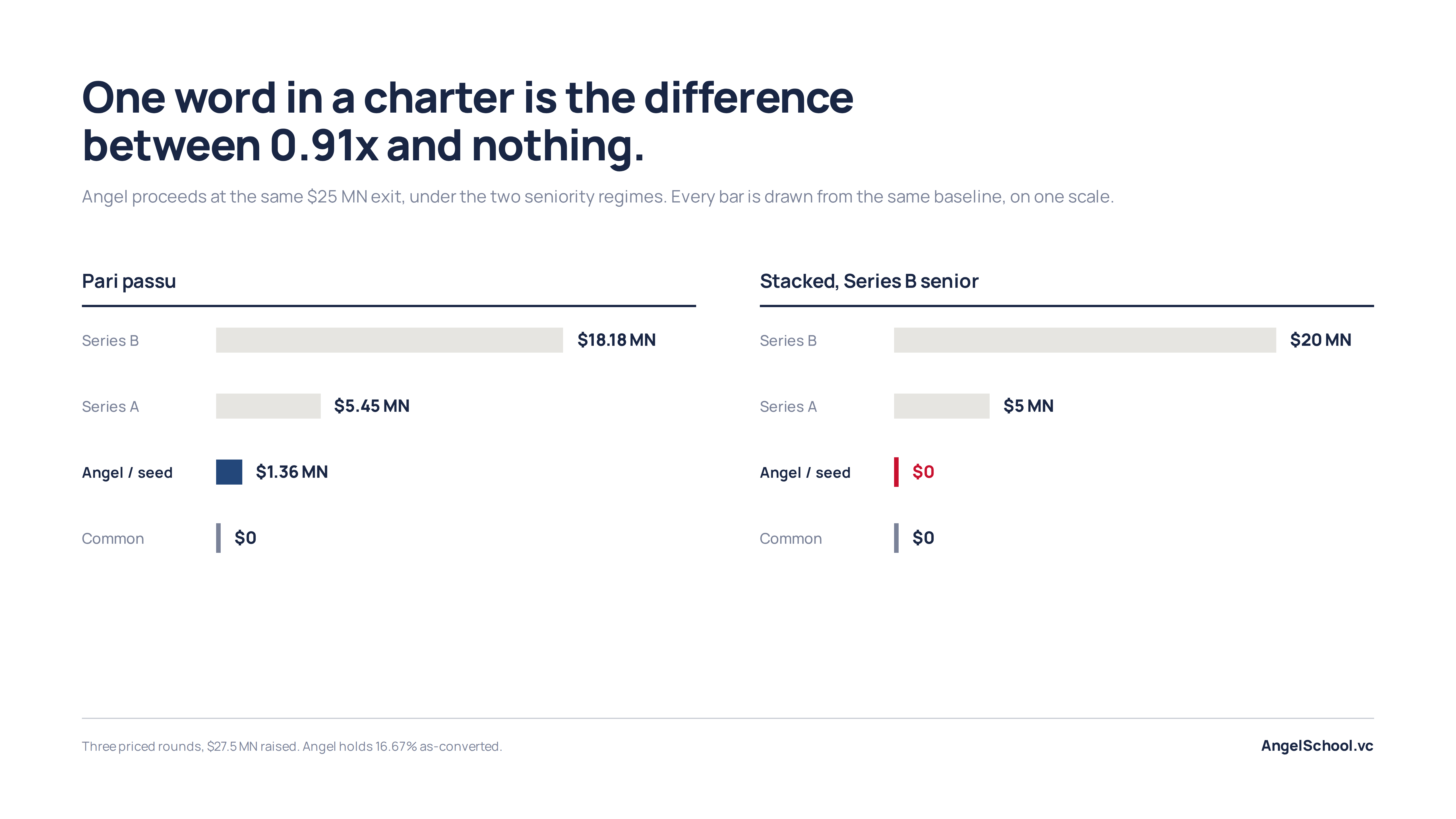
Image 1 of 2 — the same $25 million exit under pari passu and under a stacked preference.
In fact, angel investors only see liquidity if the exit value exceeds $26 MN — the value Series A and B investors invested, and reach 1x (or 100% capital recovery) at $27.5 MN.
| Exit | Angel (Distribution%) | Series A (Distribution%) | Series B (Distribution%) | Common | Angel Return Multiple |
|---|---|---|---|---|---|
| $10 MN | $0 (0%) | $0 (0%) | $10 MN (100%) | $0 MN (0%) | 0x |
| $20 MN | $0 (0%) | $0 (0%) | $20 MN (100%) | $0 MN (0%) | 0x |
| $27.5 MN | $1.5 MN (5.45%) | $6 MN (21.82%) | $20 MN (72.73%) | $0 MN (0%) | 1.0x |
| $50 MN | $6.9 MN (13.85%) | $9.23 MN (18.46%) | $20 MN (40%) | $13.85 MN (27.69%) | 4.62x |
| $100 MN | $16.67 MN (16.67%) | $22.22 MN (22.22%) | $27.78 MN (27.78%) | $33.33 MN (33.33%) | 11.11x |
Because of the preference stack, the angel investor doesn’t reach the nominal value of their investment (16.67% ownership percentage x exit value) unless the startup exits for north of $72 MN.
| Exit Value ($) | Angel receives | Multiple | Nominal value @ 16.67% ownership | Δ (Angel Liquidity - Nominal Value) |
|---|---|---|---|---|
| $10 MN | $545k | 0.36x | $1.67 MN | −67.3% |
| $25 MN | $1.4 MN | 0.91x | $4.17 MN | −67.3% |
| $27.5 MN | $1.5 MN | 1.00x | $4.58 MN | −67.3% |
| $30 MN | $1.5 MN | 1.00x | $5 MN | −70.0% |
| $50 MN | $6.9 MN | 4.62x | $8.33 MN | −16.9% |
| $72 MN | $12 MN | 8.00x | $12 MN | 0.0% |
If you want the wider picture of getting liquidity before an exit, that is a separate problem we will tackle.
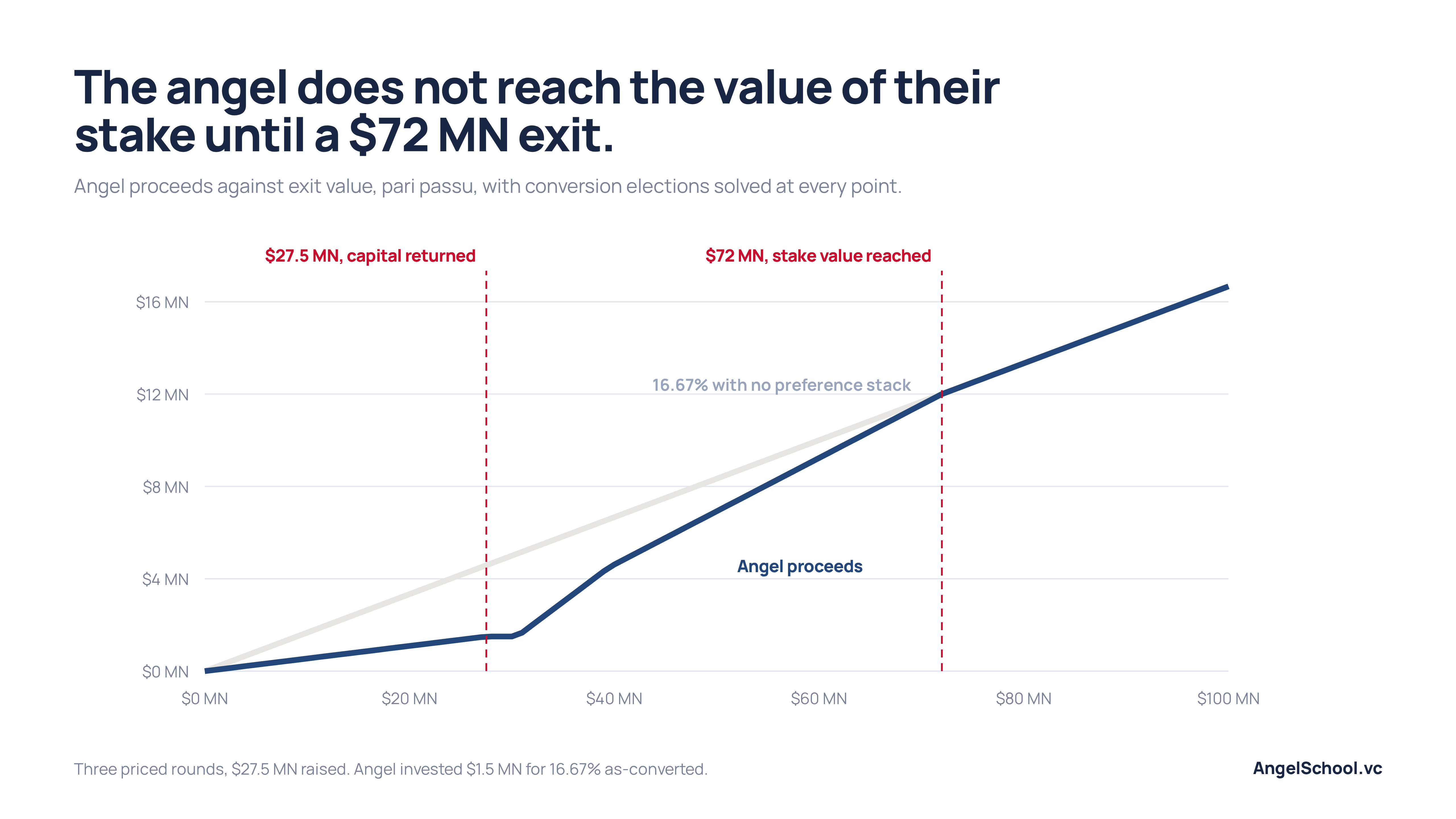
Image 2 of 2 — angel proceeds against exit value, with thresholds at $27.5 MN and $72 MN.
What it looks like when the stack moves under you.
An example of a preference structure changing after we invested was a recapitalization scenario in 2025.
This was a company which had raised multiple rounds of funding via convertible instruments because it missed its own growth targets.
Founder ownership was too diluted so an incoming investor forced a ‘founder recap’. They started a new entity, NewCo, giving prior investors 10 - 20% ownership which was a massive dilution of their ownership of 70 - 80% of OldCo.
In addition, prior investors received NewCo common shares whereas the new investor received preferred stock.
This accomplished two objectives at the same time. Firstly, it reset cap table ownership for the founders (hence, the term ‘founder recap’). Secondly, it gave the new investor 100% of liquidation preferences by subordinating other investors into common shares.
Investors had to be notified and documents had to be signed, so we saw it coming and we knew what it cost.
However, angel investors could be subject to phantom subordination. An incoming institutional investor might negotiate super pro rata, or senior liquidation preferences which earlier investors are not aware of since this is a deal done between the founders and the new investor. You likely never get to see the term sheet in the first place!
Even if you had the term sheet and spotted it, there’s nothing you can do to stop it.
What You Can Actually Do
The honest answer is: not very much. Hustle Fund put it bluntly: most angels have no leverage, and founders control the options.
The right questions to ask have to do with picking the right companies. This is why as a first principle, I’m a big advocate of due diligence.
Jason Lemkin is right, and the conclusion is not the one people expect.
SaaStr’s Jason Lemkin argues that in any successful outcome, liquidation preferences are almost completely irrelevant.
Think about what different investor rights do. Pro rata protects your upside; it gives investors the right to invest in subsequent rounds up to their original ownership percentage.
Liquidation preference on the other hand is a downside protection. It’s the right to get your money back ahead of someone else. If you’re fighting to recover original capital instead of celebrating a high multiple return, something has gone terribly wrong.
In any exit scenario, founders have far more control than investors do. They see their runway burning down. They know they need to find an exit and you can be damn sure they will secure their interests over yours.
The most common mechanism by which this happens is the founder earn-out. During exit negotiations, founders seek a cash payout from an acquirer to compensate for the years spent building the business. It’s a signing bonus to close the deal.
That gets carved out of the acquisition price which would otherwise go to investors. What’s happened is that the founders have imposed their own form of liquidation preference to circumvent investors, at a negotiating table you were not present at.
The core point is that anytime liquidation preferences come into play is one where things have gone wrong. Founder and investors have misaligned incentives.
That’s why I think investors wrongly obsess about exits — an uncontrollable event — instead of the entry which is 100% within their control. Talking about exits and scrutinizing the exit climate doesn’t make sense.
Studying exit markets to try to engineer an exit for a specific company is trying to solve a first-order problem with a third-order solution.
The path to an exit starts at entry. The questions I encourage angel investors to focus on are as follows. First, is this a fundamentally good company that can generate a venture-scale return?
Second, have you set valuation thresholds so as not to overpay? Do you know when to walk away from a bad deal?
Finally, have you built dealflow networks deep enough to mitigate adverse selection?
If you pick right, you’ll never end up in a situation where liquidation preferences matter.
Pro rata rights are usually discussed as an upside instrument — a way to maintain your ownership stake in a winning company in its next funding round. It’s also a mechanism to maintain seniority protection.
Institutional investors can impose pay-to-play rights in subsequent rounds. Investors who fund their full pro rata keep their preferred stock and the liquidation preference attached to it. Those who do not see theirs convert to common, which is the same mechanism described above.
Pay-to-play appeared in 42% of 2025 down rounds — Wilson Sonsini, Q1 2026. When pay-to-play is in place, taking your pro rata keeps you off the bottom of the preference stack. We cover how pro rata and pari passu interact separately.
Investing Through a Syndicate or an SPV
If you’re investing through a syndicate or someone else’s SPV you should be aware that economic rights and protections flow to the SPV lead, rather than to individual investors.
The SPV would receive pro rata rights if granted, and the lead decides who gets to double down. If they’re unable to exercise their pro rata, a pay-to-play condition can see the original SPV’s preferred stock convert to common, and its liquidation preference disappear with it.
Before investing through an SPV, ask the lead about the vehicle’s ability to exercise its pro rata, and their policy for who gets those rights.
What we do about it across 25 syndicates.
At the stages where syndicates play — pre-seed through Series A — the enforceable convention is to invest in preferred shares. That is near de facto for US companies but much less so in Europe and Asia, where a single share class is more common. In those cases, you may not have liquidation preferences at all.
As a general rule, all investors should always ask for pro rata, whether or not you intend to exercise it. It’s a free option that costs you nothing.
Changes to the preference stack almost always land in an institutional round with an incoming VC. You hold your rights by taking your pro rata.
This is where leading a syndicate has benefits. The investors in any given deal are a subset of a larger network that grows over time. Therefore, a syndicate has two capital pools to fill pro rata — the investors in the prior round, and everyone else.
The tension is that the more successful the company is, the higher the valuation markup, and consequently the more expensive it is to keep up with pro rata. On balance, you’re better off taking partial pro rata and leaving some on the table. It’s more common than it sounds.
Your only enforceable lever is capital access. If you’re running a syndicate, build your LP pool continuously, or get access to another. That might mean starting a fund or co-syndicating with another group. Either way it is a capital problem, not a legal one, and it is solved by building your capital base before the upround needs it.
That’s the thinking behind how we built a 1,500-LP network without marketing spend. The network is not a vanity metric. It’s a mechanism to scale capital deployments and allow us to double down and keep investors’ place on the preference stack.

If you’re looking to level up your angel investing and VC skills, check out AngelSchool.vc’s Masterclass: Venture for Angel Investors. It’s a free resource we built for the venture community.
Frequently Asked Questions
What is the difference between participating and non-participating liquidation preference?
A non-participating preference pays the holder the greater of their money back or their as-converted share of the proceeds.
A participating preference pays both: the money back first, then a pro rata share of the remaining proceeds. Participating is sometimes called a "double dip".
Non-participating is the market standard, at 96.4% of financings in Q2 2026 according to Cooley.
What does a 1x non-participating liquidation preference actually pay an angel?
Up to your original capital first, before common shareholders receive anything, and then a proportional share of whatever is left based on your ownership. It is a floor under your downside, not a bonus. Two things break it: a later investor taking a senior position ahead of you, or a later investor taking more than 1x of their money back before the sharing starts.
Is 1x non-participating good or bad for an angel investor?
It is the normal outcome and the generally best realistic starting position. It puts you ahead of common shareholders, and it doesn’t come into play in a good exit. What it does not do is protect you from whoever comes after you — a senior preference in a later round can leave you with nothing while your 1x sits intact on paper.
The structures that hurt an early investor are seniority and pay-to-play, both of which are far more common in down rounds.
Can an angel investor negotiate liquidation preference?
Almost never beyond the liquidation preferences received by angels through preferred shares or convertible instruments. Liquidation preference can be reset in a priced round from a lead investor’s term sheet which is imposed on angel investors.
As a practical matter, angel investors would do better to focus on the entry — selection, valuation discipline and pro rata rights — rather than on an uncontrollable term sheet event.
What is a preference stack and why does it matter?
The preference stack is the order in which preferred series are paid at exit. Under pari passu, all series share in the shortfall proportional to their preference.
Under a stacked structure the latest and most senior round is paid in full first. In the worked example in this article, that single difference moves the angel from 0.91x to zero at the same $25 MN exit.
Does a SAFE convert into the same shares as the new investors?
Usually not, and the difference matters. A SAFE normally converts into a sub-series — often called shadow preferred, or SAFE Preferred Stock — carrying the same rights and votes as the new money, but with its per-share liquidation amount set at the price the holder actually paid. That is what makes the preference a true 1x of the capital invested. Some older or bespoke convertible notes convert into the main series instead, which produces an aggregate preference above the cash put in.
How are liquidation proceeds on preferred stock taxed?
Proceeds on preferred stock are generally capital in character rather than ordinary income, but treatment is jurisdiction-specific and turns on the facts of the transaction and the holder's own position. This is a question for your own tax adviser, and any article that gives you a confident single answer is overreaching.
Does a company sale always trigger a liquidation preference?
Only if the charter says so. A sale triggers a preference where it is defined as a "deemed liquidation event". In In re Appraisal of GoodCents Holdings the Delaware court held that a charter's merger provision gave the preferred voting rights but not a liquidation preference, because only the dissolution section provided for one. A merger is not a liquidation unless the document makes it one.
This article describes Delaware law and general market practice. Outcomes turn on specific charter language and the facts of a given transaction, and nothing here is legal advice.
About AngelSchool.vc

AngelSchool.vc is the ultimate Accelerator for Angel Investors - from 1st check to leading syndicates as ‘Super Angels’. We give venture investors world-class training, a global community AND build their track record as a member of our Investment Committee (IC).
The AngelSchool.vc Syndicate is backed by 1500+ LPs and deploys $MNs annually. Subscribe here for exclusive dealflow.